Why We Crave Cosmic Confirmation in Love
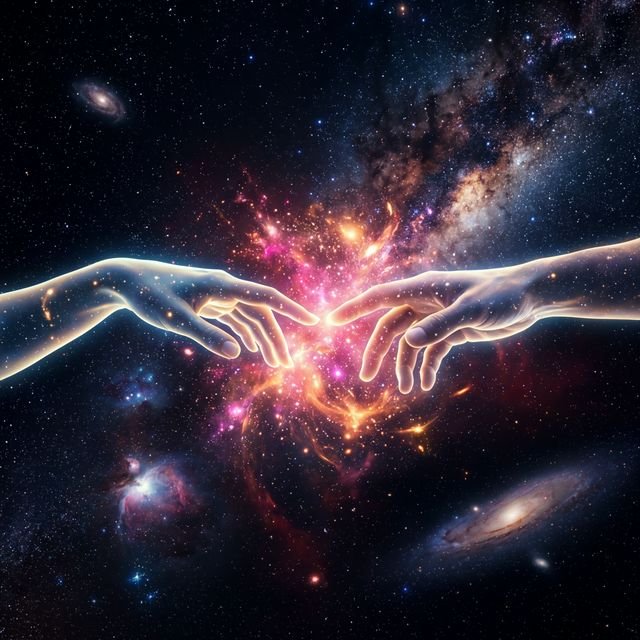
Long before compatibility calculators existed, people were reading tea leaves, consulting astrologers, and matching birth charts before arranged marriages. The tools have changed; the underlying need hasn't. Humans have always wanted something outside themselves to confirm that a relationship is meant to be — and understanding why reveals something real about how love actually feels from the inside.
Love is uncertain, and uncertainty is uncomfortable
Falling for someone puts a person in a strange position: deeply invested in an outcome they can't control or predict. That uncertainty is uncomfortable in a very specific way — it's not just "will this work out," it's "am I even reading this correctly." Cosmic confirmation, in whatever form it takes, offers relief from that discomfort by introducing a source of information that feels bigger and more objective than one person's shaky, biased judgment.
Why an external source feels more trustworthy than our own instincts
People are notoriously bad at trusting their own read on a new relationship, especially early on — hope distorts perception, past disappointment distorts it the other way. A source outside the two people involved, whether it's the stars, a numerology reading, or a compatibility percentage, feels less contaminated by that bias. It's not that people believe the stars know better in some literal sense; it's that an external source, by definition, isn't tangled up in the same hopes and fears clouding their own judgment.
The pattern shows up across every culture and era
Astrology-based matchmaking, numerology-based name compatibility, and palm reading for relationship fate all developed independently across different cultures, long before any of them could compare notes. That convergence is telling — it suggests the need for cosmic confirmation isn't a modern quirk or a product of any one belief system, but something close to a universal human response to the uncertainty love creates.
Confirmation bias does the rest of the work
Once someone gets a favorable reading — a high compatibility score, a flattering horoscope, a reassuring numerology match — confirmation bias takes over. People tend to notice and remember the details of a relationship that match the confirmation, and quietly explain away the details that don't. This isn't a flaw unique to cosmic tools; it's the same mechanism behind why any reassurance, from a friend's opinion to a fortune cookie, tends to feel more accurate after the fact than it probably was.
Why this isn't necessarily a problem
None of this makes cosmic confirmation irrational or unhealthy to enjoy. Ritual and external validation have always played a role in how humans process uncertainty, in love and elsewhere — from wedding traditions to lucky charms to simply asking a friend "do you think they like me?" Compatibility tools are a modern, low-stakes version of the same instinct, and there's nothing wrong with using them exactly as intended: not as a replacement for judgment, but as a small, comforting ritual alongside it.
The takeaway
The craving for cosmic confirmation says less about whether the stars or the numbers actually know anything, and more about how universally uncomfortable uncertainty in love feels — and how far back that discomfort goes. Whether the confirmation comes from a birth chart, a name calculator, or a friend's reassurance, the need behind it is the same one humans have carried for as long as they've fallen for each other.
The digital-age version of an ancient habit
What's changed isn't the underlying craving but the speed and accessibility of the ritual. Where a birth chart once required a trained astrologer and a formal consultation, a compatibility score now takes seconds and costs nothing. That shift hasn't reduced the appeal — if anything, the instant, low-effort version fits even more naturally into how people process everyday uncertainty, from a first date to a years-long relationship hitting a rough patch. The ritual got faster; the reason people reach for it stayed exactly the same.
A healthy way to hold the need
None of this is a reason to feel embarrassed about wanting cosmic confirmation, and it's also not a reason to let it replace real judgment. The healthiest relationship to this instinct treats it as one small, enjoyable part of processing love's uncertainty — alongside honest conversation, observed behavior, and time — rather than the deciding factor. Humans have always needed a little outside reassurance in matters of the heart. Knowing why makes it easier to enjoy that reassurance without mistaking it for the whole answer.